
DuraFlex Chimney Sweep in Pacific Beach: A Homeowner’s Guide
If you have a stainless steel liner in your Pacific Beach chimney, there’s a good chance it’s a DuraFlex system, and an equally good chance you’ve never heard the name. DuraFlex liners are sold through professional chimney trade suppliers, not retail hardware stores, which means most homeowners who have one installed don’t know the brand name, the alloy grade, or the cleaning protocol that keeps the warranty valid. This guide explains what a DuraFlex liner actually is, how to maintain it, and what to watch for as it ages. If you’d rather not sort through liner specifications yourself, call (866) 282-7711 and we’ll take a look.
We’re chimney technicians in Pacific Beach, and we work with these systems every week. Here’s what you need to know.
What Is a DuraFlex Liner, Exactly?
DuraFlex is a flexible stainless steel chimney liner manufactured by Copperfield, a chimney trade supplier. The liner is corrugated, which gives it the flexibility to snake down through an existing flue, and it comes in two primary alloy grades: 316Ti and 304 stainless. The alloy matters more than most homeowners realize. In our experience across Pacific Beach, we see 316Ti specified for wood-burning fireplaces and high-efficiency gas appliances because it holds up better against acidic condensate and higher flue temperatures. 304 is adequate for natural gas appliances with lower exhaust temperatures, but it corrodes faster when exposed to the byproducts of wood combustion.
The corrugation isn’t just for flexibility. Those ridges increase surface area and create turbulence in the flue gas stream, which affects draft performance. A properly installed DuraFlex liner restores draft to a deteriorating clay tile flue, but the installation has to match the appliance. Putting a wood-burning liner on a gas appliance, or vice versa, creates problems that show up as poor draft, excessive creosote, or premature corrosion. The liner’s job is to contain combustion byproducts and direct them out of your home. When the alloy grade or sizing is wrong, it can’t do that job for long.
The relevant comparison for Pacific Beach homeowners is straightforward: a clay tile flue that’s cracked or spalling either gets relined or it keeps leaking exhaust into the home. DuraFlex is one of the most common relining choices because it can be installed in a day without tearing out masonry, and the product is proven across decades of use. The installation is still specialized work. We’ve pulled out liners in Pacific Beach that were sized wrong or left uninsulated, and the failure took two or three years to show up, but it always did.
How Cleaning a DuraFlex Liner Differs From a Clay Tile Flue
Cleaning a flexible stainless liner is not the same job as sweeping a traditional clay tile flue, and using the wrong tools is where a lot of damage happens. Clay tiles can handle aggressive brushing. A corrugated stainless liner cannot. The metal is thinner than most homeowners expect, and the ridges are vulnerable to deforming if a sweep uses an oversized wire brush or applies too much pressure. Once the corrugation is crushed or dented, the liner’s draft characteristics change, and in the worst cases the damage creates a catch point where creosote and debris accumulate faster.
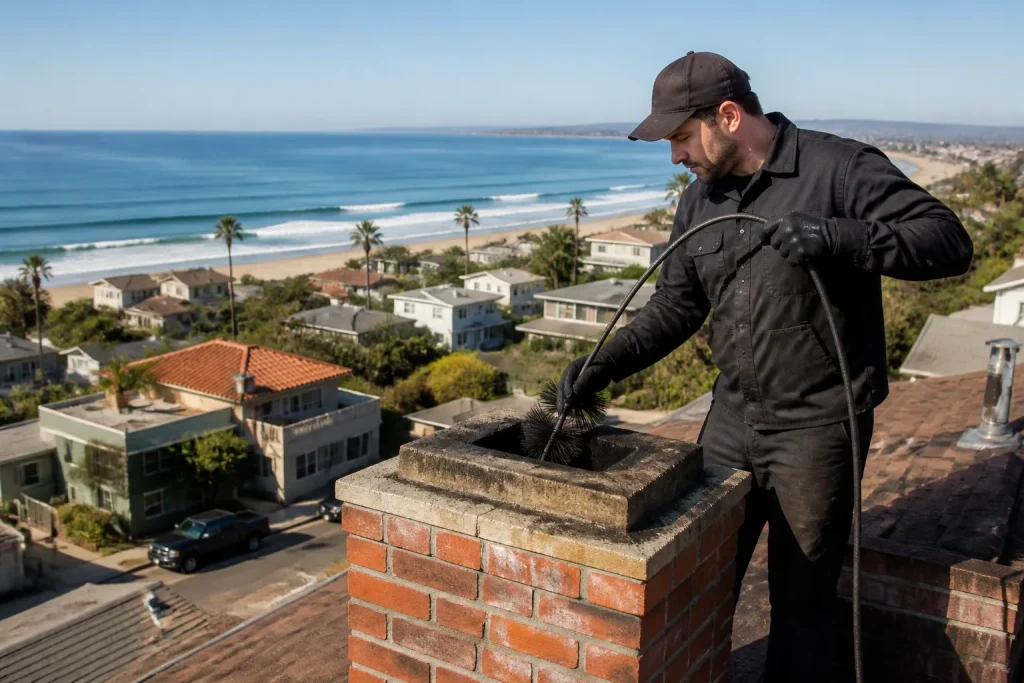
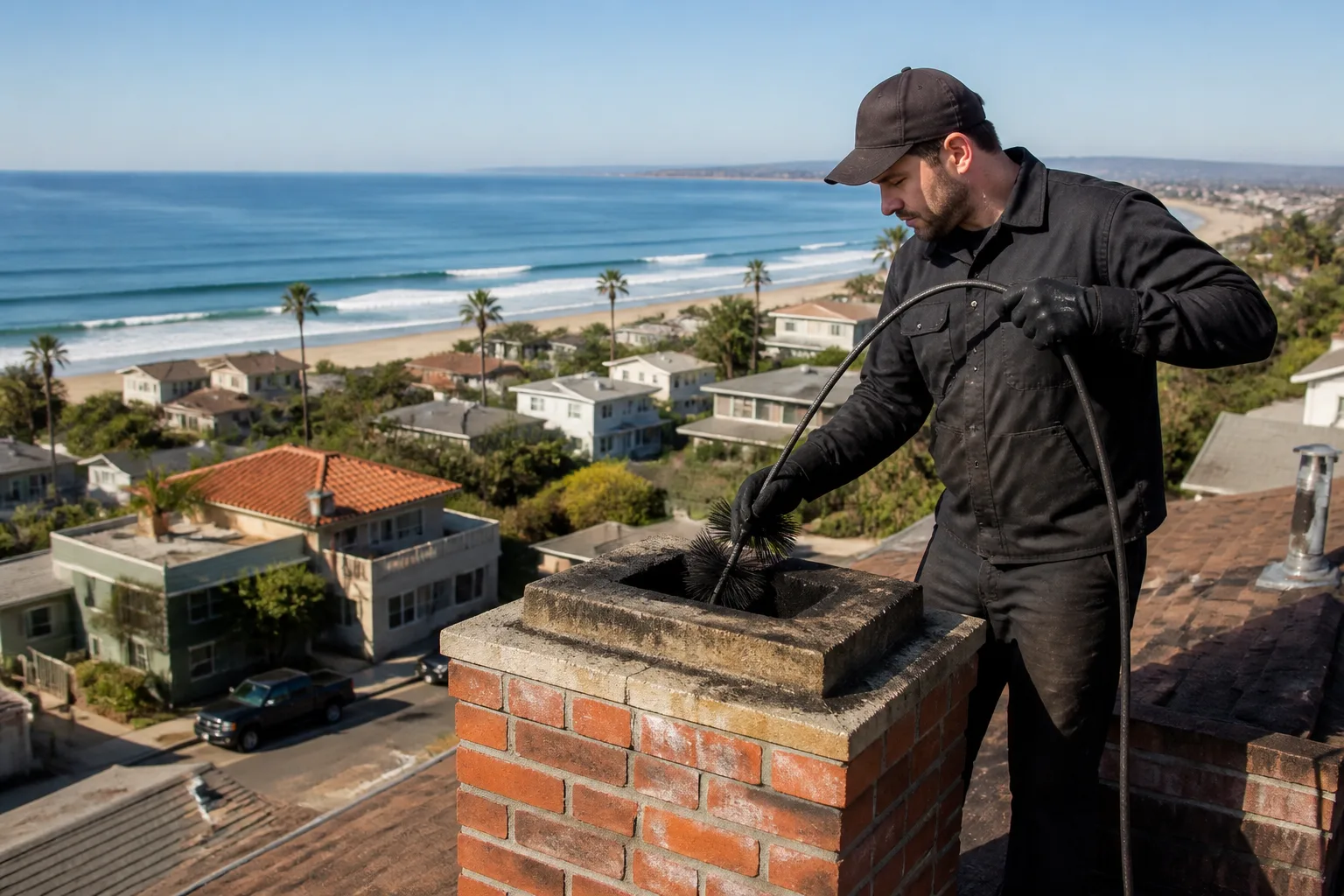
For a standard DuraFlex sweep, we use a brush sized to the liner’s interior diameter, typically a poly or softer wire brush rather than the aggressive steel brushes used on clay tiles. The goal is to remove creosote and soot without scoring the metal or deforming the corrugation. We also work from the top down in most Pacific Beach installations, which lets us control pressure and inspect the liner as we go. The inspection matters because a flexible liner can develop problems that a clay flue never will: joint separation, collapsed corrugation, and loosening at the appliance collar where the liner connects to the stove or fireplace insert.
Creosote behaves differently on stainless steel than it does on clay. Because the metal heats and cools quickly, it tends to produce a flakier, drier creosote in wood-burning applications, which is generally easier to remove than the dense, tarry creosote that forms on cold clay. That said, Pacific Beach’s marine air means stainless liners here are exposed to salt-laden humidity, and we’ve seen liners that sat unused for a summer develop light surface corrosion that made the first sweep of the season more involved. Regular use and annual cleaning keep that in check.
If you have an older liner and aren’t sure whether it’s DuraFlex or another brand, the easiest check is at the appliance collar. DuraFlex liners typically have a tag or stamping at the top or bottom connection. No tag? The corrugation pattern on DuraFlex is distinctive to a trained eye, and we can usually identify it on sight.
Insulation Wrap: What San Diego Jurisdictions Require and How to Check Yours
Most San Diego County jurisdictions require an insulation wrap on flexible stainless liners installed in masonry chimneys, and Pacific Beach is no exception. The wrap, typically a ceramic or foil-backed insulation blanket, serves two purposes. It keeps flue gases hot enough to maintain draft, and it prevents the liner from transferring too much heat to the surrounding masonry. The second function matters more than most people think. A liner that sits too close to combustible framing, or that radiates heat through cracked masonry, is a fire risk.
Verifying that your liner has an insulation wrap without opening the chase is doable, but it requires either a chimney camera inspection or removal of the appliance connection to look up the first few feet. Our camera inspections through the appliance collar can usually confirm whether insulation is present and whether it’s intact. We’ve seen cases in Pacific Beach where the wrap was installed but had settled or torn, leaving sections of bare liner against masonry. That’s not an emergency in every case, but it is a condition you want to know about before running a wood fire on a cold January night.
The practical takeaway: if your liner was installed by a licensed contractor in Pacific Beach within the last decade, it very likely has an insulation wrap. If it was installed by a handyman or as part of a flipper renovation, you should verify. The presence or absence of insulation isn’t something you can eyeball from the top of the chimney, which is why we recommend a camera inspection whenever homeowners are uncertain about their liner’s installation details. The inspection gives you a visual record, and the record tells you exactly what you own.
Signs a DuraFlex Liner Is Developing a Failure Point
DuraFlex liners are a proven product, but they’re not immune to installation errors, and installation errors are what we see most often in Pacific Beach. Here are the failure signals we look for during every inspection:
- Joint separation. Flexible liners are joined in sections, and the connections can pull apart if the liner wasn’t properly supported or if the chimney moves. A separated joint leaks exhaust into the chimney chase, which you’ll usually notice as a smell of smoke inside the house even when the fireplace isn’t in use.
- Collapsed corrugation. We’ve seen liners where a section of corrugation was crushed during installation, usually because someone forced it through an offset without using the proper fittings. The crushed section restricts draft and creates a creosote trap.
- Loosened appliance collar. The connection where the liner meets the stove or insert collar is the most common failure point we see. Vibration from the appliance, thermal expansion, and a poor initial fit all work the connection loose over time.
- Corrosion at the base. The bottom few feet of a liner see the coolest temperatures and the most condensation, which is where corrosion starts. On gas appliances in Pacific Beach, we look for a pattern of pitting or flaking at the base that indicates the alloy grade might be wrong for the application.
If any of these conditions is present, the fix is usually localized rather than requiring a full replacement, but only if you catch it early. A small joint separation can be resealed. A collar that’s loose can be refitted. Once a liner has been compromised to the point where creosote has built up behind it, you’re looking at a more expensive repair. This is why we recommend an annual inspection even in years when you don’t burn much. The oceanside humidity in Pacific Beach doesn’t help stainless liners rest easy, and the problems that cost the most to fix are the ones that went unnoticed for three or four years.
Warranty Coverage and the Cleaning Records That Keep It Valid
DuraFlex liners carry a manufacturer’s warranty, but the coverage is narrower than the lifetime language on the packaging suggests. The warranty from Copperfield covers manufacturing defects in the liner material itself, which are rare. It does not cover damage from improper installation, wrong fuel type, chimney fires, or lack of maintenance. The installation is almost always the variable that determines whether a liner lasts 5 years or 30.
The maintenance condition matters because most liner warranties require annual documented cleaning and inspection by a qualified chimney professional. The keyword is documented. A receipt from a chimney sweep in Pacific Beach that says “sweep performed” without any detail may not satisfy a warranty claim. What you want is a record that states the liner type, the cleaning method used, and the condition of the liner at the time of service. We provide that record for every DuraFlex liner we clean, and we recommend homeowners keep it somewhere accessible. If you sell the house, the buyer’s inspector will often want to see it too.
One point that surprises homeowners: a chimney fire voids most liner warranties immediately, even if the liner appears visually intact. The thermal shock of a chimney fire can damage the metal’s temper in ways that aren’t visible, and manufacturers don’t want the liability. The practical rule is simple: clean your liner annually, burn properly seasoned wood if you have a wood-burning fireplace, and don’t let a small creosote problem become a large one.
If you’re not sure what liner you have or whether your maintenance records are up to date, start with a camera inspection. We’ll tell you what you have, what condition it’s in, and what it actually needs, without upselling you on work that can safely wait. That’s the standard we hold ourselves to on every chimney job in Pacific Beach.
When to Call a Pro
Certain liner issues are safe to monitor, but most are not safe to ignore. Call a professional if you notice a smoke smell inside the house, visible rust staining on the chimney chase, a drop in draft that makes the room smell like a campfire when the wind shifts, or if you’ve simply never seen your liner and don’t know its installation history. A camera inspection costs less than the repair you’ll face if a small joint separation goes unnoticed for a few seasons.
Related services in Pacific Beach: Chimney Sweep in Pacific Beach for annual maintenance and liner cleaning, Chimney Repair in Pacific Beach for liner inspection and localized repairs, and Dryer Vent Cleaning in Pacific Beach to address the other major ventilation fire risk in the home. We handle all three in-house.
We also work with Chimney Sweep Pacific Beach home to keep our full service details and scheduling information current for local homeowners.
The Bottom Line
A DuraFlex liner is a good product, but the installation quality and the ongoing maintenance determine whether it does its job for decades or fails early. Know what alloy grade you have, verify that the insulation wrap is present and intact, keep an eye on the appliance collar connection, and get an annual camera inspection even if you only burn occasionally. The homeowners we see in Pacific Beach who follow that routine rarely have surprise liner failures. The ones who don’t are usually calling us because something already went wrong.
If you’re in Pacific Beach and want to know exactly what’s in your chimney, Chimney Sweep Pacific Beach offers camera inspections and free estimates for liner work. Call (866) 282-7711 and we’ll work out a time that fits your schedule.
Frequently Asked Questions
A DuraFlex liner installation in Pacific Beach typically runs between $2,500 and $5,500 depending on the chimney height, appliance type, and whether an insulation wrap is required. The liner material itself is a meaningful part of that cost, but labor and access are the bigger variables. Homes with steep rooflines in beachside Pacific Beach neighborhoods tend to cost more because of the access work involved. Call (866) 282-7711 for an exact quote on your chimney.
Once a year, same as any other chimney liner. If you burn wood more than three times a week during the season in Pacific Beach, you may need a mid-season sweep as well. The annual cleaning is also the condition that keeps the manufacturer’s warranty valid, so skipping a year has a financial consequence beyond the creosote buildup.
You can buy a brush and rods and attempt it, but we don’t recommend it. The risk of deforming the corrugation with an oversized or overly aggressive brush is real, and the replacement cost for a damaged section of liner exceeds what you’d spend on professional cleaning for the entire time you own the home. We’ve repaired DIY liner damage in Pacific Beach more times than we can count.
A chimney fire voids the manufacturer’s warranty and can compromise the liner’s structural integrity even if it looks fine from the outside. The metal heats past its design threshold and the temper changes, making future failure more likely. If you’ve had a chimney fire, get a camera inspection before using the fireplace again. Call (866) 282-7711 to schedule one.
Written by the team at Chimney Sweep Pacific Beach, serving Pacific Beach since 2012.
Need Chimney Cleaning Help?
Call Chimney Sweep Pacific Beach - licensed & insured, here with fast help in Pacific Beach.
(866) 282-7711